
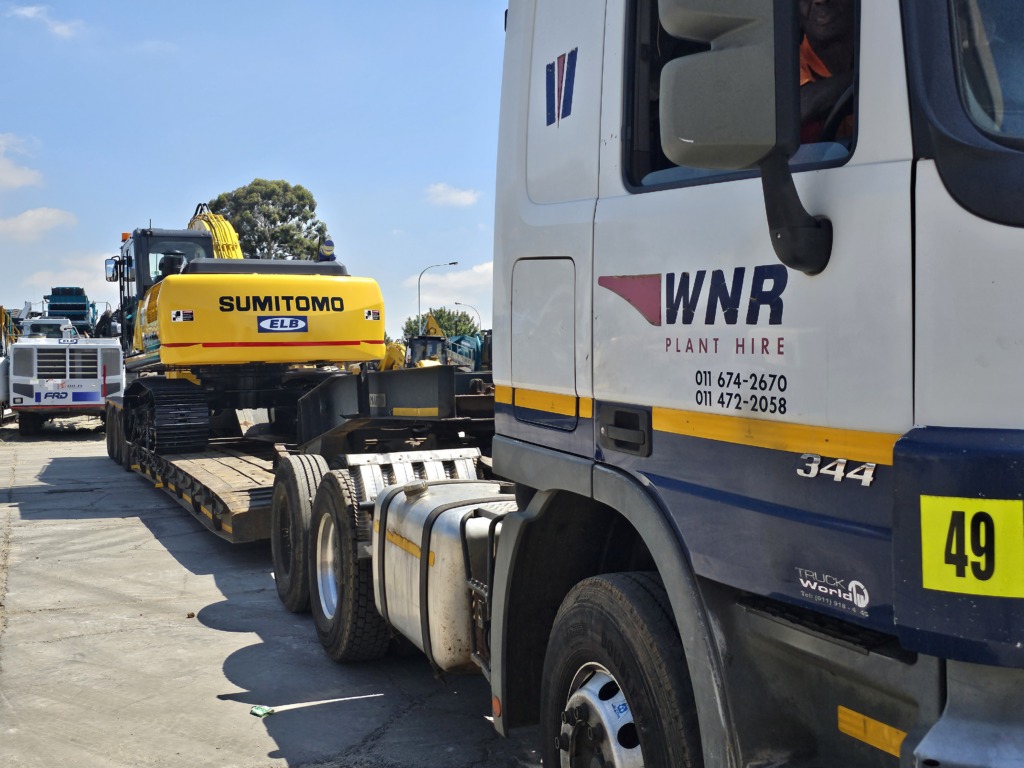
Every contractor eventually faces the same question: the machine is here, the work is there, so how does it get across? Some plant can be driven to the next site. Some fits on an ordinary trailer. And some can only move safely and legally on a lowbed. Getting the decision right saves time, protects the machine and keeps you on the right side of the road rules.
WNR Plant Hire has been moving heavy plant since 1957, when the business started as Du Randt Vervoer. Here’s how we think about the decision.
Question 1: Can the machine drive there?
Some machines are built to travel on their own. Our tipper trucks, for example, are licensed, roadworthy vehicles that can drive on public roads, so they don’t need transport at all.
Other machines may be able to travel short distances under their own power, but that doesn’t mean they should. Before driving a machine between sites, ask:
- Is it road legal? Most earthmoving plant is not designed or licensed for public roads.
- What will it damage? Tracked machines like excavators can wreck tar surfaces and kerbs.
- How far is it? Slow plant on a busy Gauteng road is a safety risk to everyone around it.
- What does it cost in wear? Tracks, undercarriage and tyres wear out faster on long tramming.
If the move is only across the same site, driving it is usually right. Between sites, on public roads, it usually isn’t.
Question 2: Is it small enough for a normal trailer?
Light, compact equipment can sometimes go on a standard flatbed or plant trailer. The limits are height and weight. A normal deck sits high, so a tall machine on top of it quickly runs into height problems, and a heavy machine can exceed what a lighter trailer and truck are rated for.
As a rule of thumb, once you’re dealing with mid-size and bigger earthmoving plant, a standard trailer stops being a sensible option.
Question 3: Does it need a lowbed?
A lowbed has a deck that sits much closer to the road. That lower deck is the point: it keeps the overall height of a tall machine down and carries heavy loads with a low centre of gravity. Loading is also easier, because the machine climbs a short ramp rather than a steep one.
You need a lowbed when:
- The machine is heavy. Excavators, graders, wheel loaders and rollers fall into this group.
- The machine is tall. A standard deck would push the total height too high.
- The machine is tracked. It can’t be driven on public roads without damage.
- The load is abnormal. WNR does abnormal loads. Enquire with the load details for more information.
Common machines and how they usually move
| Machine | Usual way to move between sites |
|---|---|
| Excavator (21 t, 24 t or 30 t) | Lowbed |
| Grader | Lowbed |
| Wheel loader | Lowbed |
| Roller (12 t or 18 t) | Lowbed |
| 4×4 TLB | Often a lowbed, depending on distance and route |
| Tipper truck | Drives itself (licensed and roadworthy) |
Every situation is different, so use this as a starting point, not a final answer.
When the decision isn’t obvious
Some moves sit in a grey area: a TLB going a short distance, a machine with a long boom, or a site with tight access where a lowbed can’t turn. In those cases the details decide. What’s the machine, how far is it going, and what’s the access like at both ends?
You don’t have to work it out alone. Tell us the machine and the route and we’ll advise whether it needs a lowbed. When you’re ready to book, our guide on how to plan a plant move covers what to send us.
Hire and transport from one company
When you hire plant from WNR, an operator is always supplied, and moving the machine to and from site on our own lowbeds is part of the same conversation. We also move contractors’ own plant. We work all across Gauteng from our base in Roodepoort, with lowbed transport in Gauteng alongside excavator hire and tipper trucks.
To pay, you can either complete WNR’s credit application for a 30-day account, or pay upfront or a deposit.
FAQ
Can an excavator be driven to a nearby site?
On the same site, yes. Between sites on public roads, a tracked excavator should go on a lowbed.
What’s the difference between a lowbed and a flatbed?
A lowbed’s deck sits much lower, which keeps tall, heavy machines within height limits and makes loading safer.
Do your lowbeds take abnormal loads?
Yes, we do abnormal loads. Enquire with the load details for more information.
Do tipper trucks need a lowbed?
No. Our tippers are licensed, roadworthy vehicles that drive on public roads.
Where do you operate?
All across Gauteng.
Not sure how your machine should move? Request a quote or call 011 674 2670.